
How to Self-Manage Your Airbnb Property in October 2026
Most hosts think it's a management company or paid software. Both cost you. There's a third path that automates everything and costs qualifying hosts nothing.
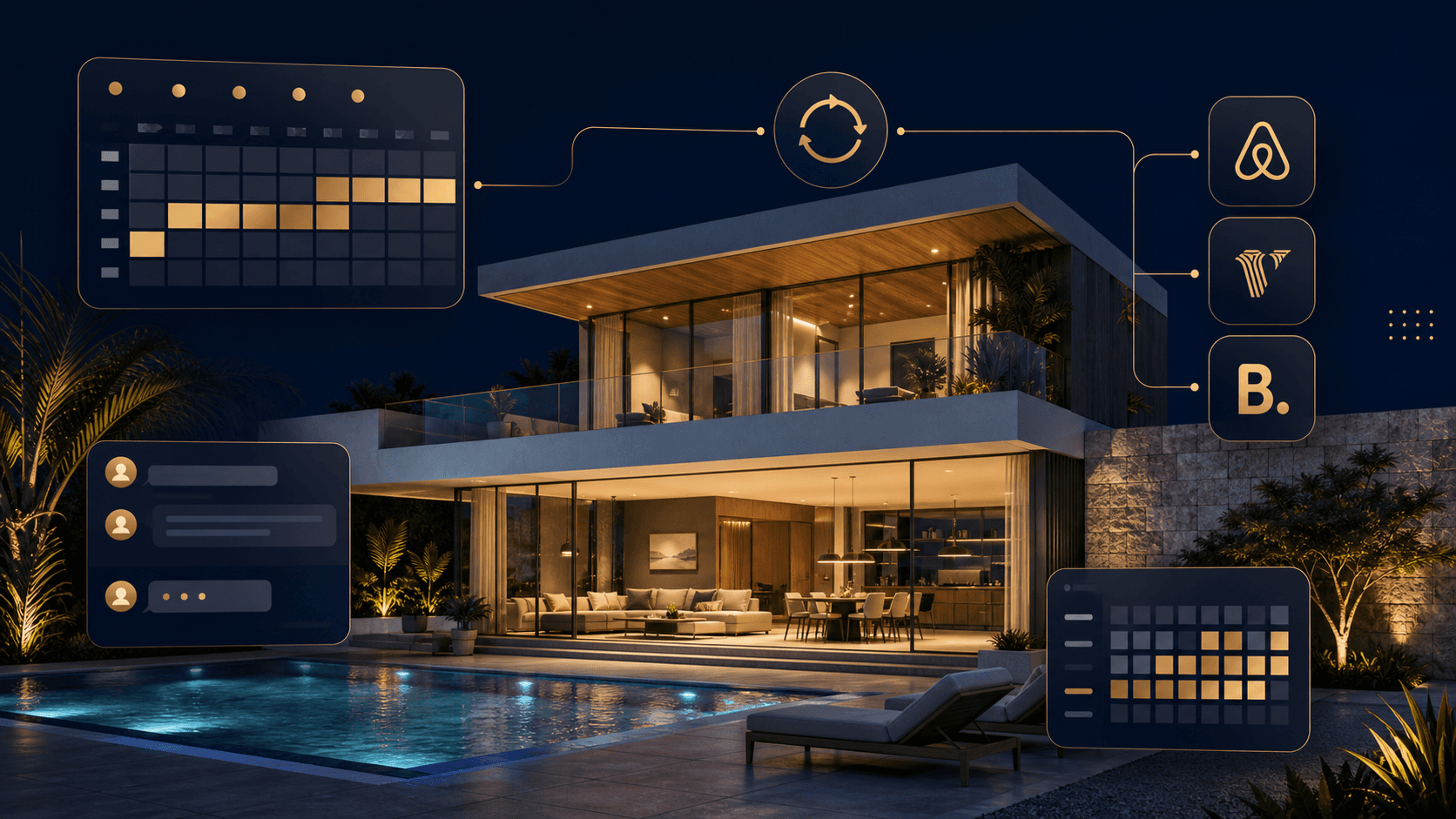
Hand your property to a management company and you're giving up 15% to 40% of every booking. Pay for property management software and you're often looking at $360 to $1,000+ per year before demand-based pricing, analytics, or vendor coordination are even included. Most hosts assume those are the only two options. There's a third path that covers everything both charge for and costs qualifying hosts nothing.
Here's how to run your Airbnb without writing a check for either.
TLDR:
- Property management companies take 15% to 40% of gross rental income, costing $9,000 to $24,000/year on a $60K property
- iCal calendar sync has multi-hour lag gaps; API connections block availability across channels in seconds
- Most "free" property management tools charge separately for demand-based pricing, automated messaging, and vendor coordination
- No single booking channel reaches more than 44% of guests, so multi-channel distribution requires airtight calendar sync
- Andora syncs listings across Airbnb, VRBO, Booking.com, Marriott Homes and Villas, and Rove Travel at no cost to qualifying hosts
What Airbnb Property Management Actually Covers
Airbnb property management covers every task that sits between owning a rental property and getting paid for it, which is a wider range of work than most new hosts expect.
At the core, it breaks down into four areas:
- Listing and pricing: writing and updating your listing, setting nightly rates, and adjusting for seasonality and demand
- Guest communication: answering inquiries, sending check-in instructions, handling issues mid-stay, and requesting reviews
- Turnover coordination: scheduling cleaners, tracking maintenance, and making sure the property is guest-ready after every checkout
- Channel and calendar management: keeping availability accurate across every booking site you are listed on
Each area involves ongoing, repetitive work. Guest messages arrive at all hours, cleaners need confirming after every booking, and pricing that made sense in June may leave money on the table in August. None of it pauses between guests.
The question for any host is how much to handle personally, how much to hand off to a management company, and how much a software tool can take care of automatically.
What an Airbnb Property Manager Does
A property manager handles the full scope of what it takes to keep a rental booked and running: writing and optimizing listings, adjusting pricing dynamically, fielding every guest message from initial inquiry through checkout, and coordinating cleaners between each stay.
Beyond the guest-facing work, there is maintenance tracking, local compliance (permits, taxes, occupancy rules), and review management. Reviews feed directly into search rankings on Airbnb, so following up after each stay matters more than most hosts expect.
The workload compounds fast with multiple properties, which is exactly why Airbnb property management fees range widely of rental income.
Self-Managing vs. Hiring a Property Management Company
Hiring out simplifies operations but carries a real cost. Property management companies typically take 15% to 40% of gross rental income, according to AirDNA's fee breakdown. On a property generating $60,000 per year, that is anywhere from $9,000 to $24,000 leaving your pocket annually.
Self-managing keeps that margin but demands your time. Guest messages, cleaner scheduling, pricing adjustments, calendar updates: it all falls on you. For a single property, many hosts find it manageable. For two or more, the hours compound quickly.
Here is what you are actually trading between the two approaches:
- Self-managing: higher net income, higher time commitment, requires systems in place to stay organized
- Hiring a company: less daily involvement, lower net income, and service quality that varies widely by provider
| Factor | Self-Managing | Hiring a Property Management Company |
|---|---|---|
| Management fee | $0 | 15% to 40% of gross rental income |
| Annual cost (on $60K property) | $0 | $9,000 to $24,000 |
| Time commitment | Higher (requires systems in place) | Lower (company handles daily tasks) |
| Net income | Higher | Lower |
| Control over operations | Full | Limited |
| Service quality consistency | Depends on your systems | Varies widely by provider |
Most hosts land somewhere in the middle: they want to stay in control but need tools that remove the repetitive work. That is where software changes the equation.
How Airbnb Property Management Software Works
Property management software connects your booking channels, guest communications, and operations into one place so you are not logging into five different apps to piece together what is happening at your property.
The core functions most tools cover:
- Reservation management: all bookings from every channel in one dashboard
- Unified inbox: guest messages from Airbnb, VRBO, Booking.com, and others pulled into a single thread
- Calendar sync: availability updated across channels in real time when a booking lands
- Automated messaging: pre-arrival instructions, check-in details, and checkout reminders sent without manual effort
- Vendor coordination: cleaner scheduling triggered automatically after each checkout
- Demand-based pricing: nightly rates adjusted based on demand, local events, and seasonality
The difference between tools comes down to what is included versus what costs extra. Most paid software bundles the inbox and calendar sync, then charges add-on fees for demand-based pricing or task management. Free options tend to strip features down considerably. The gap between what the software promises and what you actually get at the base price is where most hosts get surprised.
How to Sync Your Vacation Rental Calendar Across Airbnb, VRBO, and Booking.com
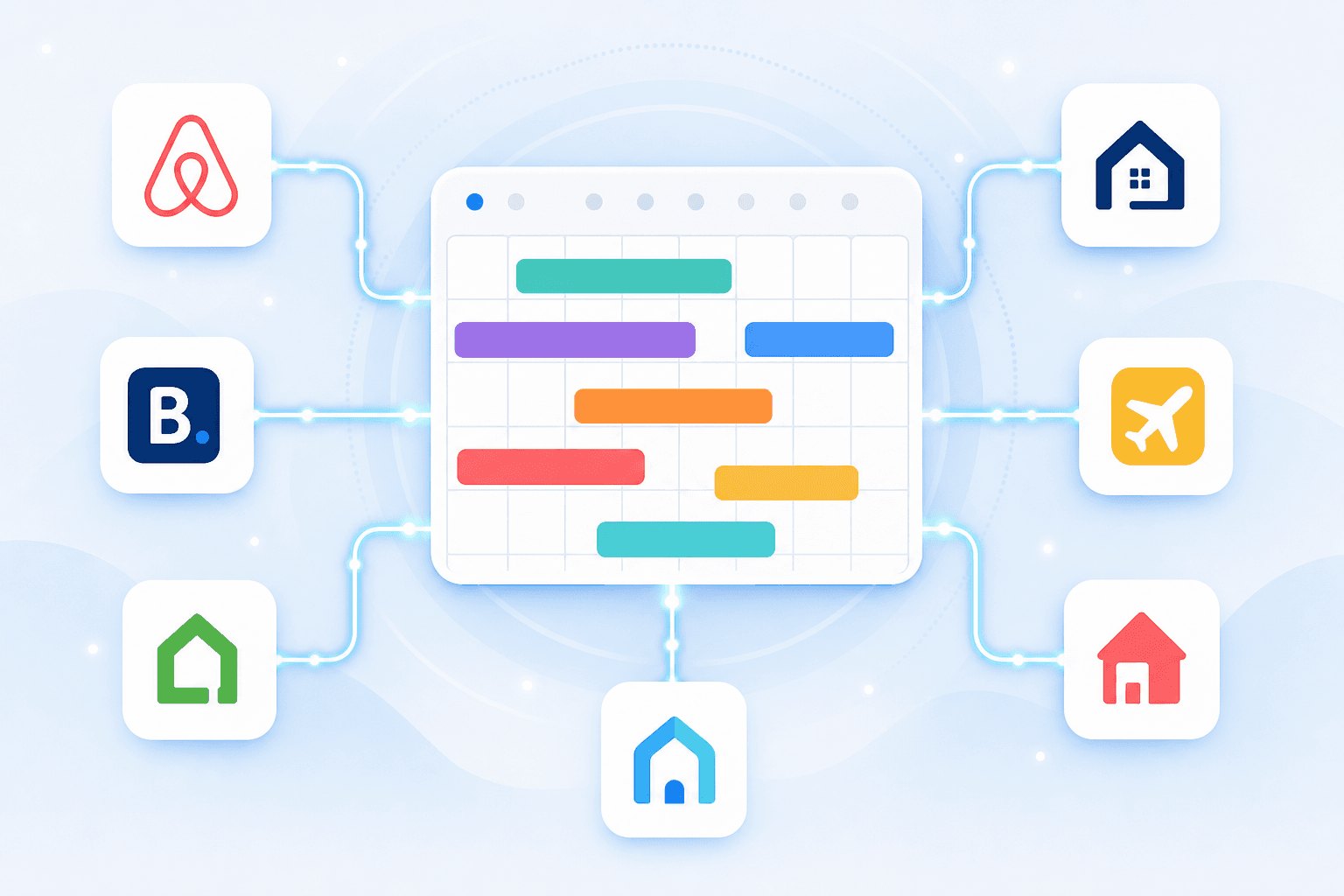
Two methods exist for keeping calendars in sync across booking channels: iCal and API.
iCal is the simpler option. Each platform exports a calendar link you import into the others. The problem is lag. iCal updates on a polling schedule, sometimes refreshing only every few hours. In that window, as ReservationKey explains, a booking on one channel can go undetected long enough for a second guest to book the same dates elsewhere.
API connections are faster. A direct integration between your property management software and each channel pushes availability changes instantly when a booking confirms, with no polling delay and no gap for overlap.
The catch is that API access requires a channel manager or PMS that maintains certified integrations with each platform. iCal is available to anyone; API sync is not.
How to Prevent Double Bookings When Listing on Multiple Platforms
Double bookings usually happen in the gap between when a reservation confirms on one channel and when that update reaches the others. With iCal, that gap can be hours. With API connections, it closes in seconds.
A few steps that reduce the risk:
- Use a channel manager with real-time API sync instead of iCal exports alone, so calendar updates propagate immediately across every listing.
- Let the software block dates automatically after a booking instead of doing it by hand, which introduces lag and human error.
- Keep a single master calendar as your source of truth instead of managing individual channel calendars separately.
- Avoid accepting instant bookings on multiple channels without automated blocking already in place.
The safest setup is a property management tool that blocks all connected calendars the moment any booking confirms, regardless of which channel it came from. iCal-only hosts are always one slow refresh away from a conflict, and a double booking means refunds, penalties, and a damaged review record.
What Property Management Software Works With Marriott Homes and Villas
Marriott Homes and Villas does not accept direct listings the way Airbnb does. Access runs through approved connectivity partners, meaning certified PMS and channel manager integrations that meet Marriott's technical requirements. If your software is not on that list, you cannot distribute to Marriott's network, regardless of your property's quality.
Most mainstream PMS tools do not have this connection. Andora does. It syncs listings across Marriott Homes and Villas alongside Airbnb, VRBO, Booking.com, and the Rove Travel marketplace from a single calendar view, with real-time API sync and none of the iCal delays.
What to Look for in Free or Low-Cost Airbnb Property Management Software
"Free" in this category rarely means what it sounds like. Most tools offer a free tier that covers the inbox and calendar, then charge separately for demand-based pricing, analytics, and vendor coordination. Before committing, ask what is actually included at $0 versus what requires an upgrade.
A few things worth checking:
- Which channels sync at the free tier, since some tools limit you to one or two listing sources
- Whether demand-based pricing is included or sold as a separate add-on
- If automated messaging requires a paid plan to activate
- What the per-property or per-booking fee structure looks like as your portfolio grows
The total cost often looks quite different once those add-ons stack up.
How to Become an Airbnb Property Manager
Managing properties for other owners starts with the same skills that make a good host: responsive communication, organized turnover coordination, and pricing awareness. The difference is that you are running someone else's asset, which adds accountability for revenue performance and clear reporting.
The typical path looks like this:
- Start with co-hosting on your own or a friend's property to build a track record
- Learn local short-term rental regulations, since licensing requirements vary by city and state
- Set your fee structure, as most independent managers charge 15% to 25% of gross revenue
- Build a simple portfolio showing occupancy rates and review scores you have managed
- Use a property management system from day one so your operations look professional from the first client
Formal certification programs exist but are not required. Experience and results carry more weight with prospective clients than credentials do, and the Andora blog covers more on building that track record.
How Much Airbnb Property Managers Earn
Independent managers earn through the percentage model: typically 15% to 40% of gross rental income, with full-service arrangements averaging 20% to 25%. On a property generating $80,000 annually, a 20% cut equals $16,000 from a single client. Scale that to five properties and the income becomes meaningful without salaried employment.
Salaried roles at property management companies work differently. Compensation ties to experience and portfolio size, not individual property revenue. Entry-level roles focus on guest communication and turnover coordination, while senior managers oversee larger portfolios, handle owner relationships, and often earn performance bonuses tied to occupancy or revenue targets.
How to Manage Your Airbnb Property Without a Management Company
Running a property without a management company comes down to having the right systems in place before guests arrive, not scrambling to build them after.
The core of a self-management setup:
- A unified inbox that pulls messages from every booking channel into one place, so nothing slips through when an Airbnb inquiry lands at the same time as a VRBO question
- Automated messaging sequences for pre-arrival, check-in, and checkout so you are not manually sending the same instructions to every guest
- A cleaner dispatch system tied to your calendar, triggering automatically after each checkout without requiring a manual text every time
- Real-time calendar sync across all channels so a booking on one site blocks availability everywhere else instantly
- Demand-based pricing that adjusts nightly rates based on demand, local events, and seasonality without requiring daily manual updates
With these in place, most of the repetitive daily work disappears. Guest questions get answered around the clock, turnovers get scheduled without your involvement, and your calendar stays accurate across every channel.
The last piece is distribution. Listing on a single channel caps your reach, and no single booking channel reaches all potential guests. Multi-channel distribution means more bookings, but only works if your calendar sync is airtight.
How Andora Lets Luxury Hosts Self-Manage at Zero Cost
Everything described in the self-management setup above is what Andora automates, at no cost to qualifying luxury hosts.

Most property management software charges $360 to $1,000+ per year and still locks demand-based pricing, analytics, and vendor coordination behind add-ons. Andora includes all of it for free. The AI Guest Concierge resolves 9 in 10 messages automatically, in your voice, around the clock. The Calendar Sync Agent blocks every connected channel the moment a booking confirms, keeping Airbnb, VRBO, Booking.com, Marriott Homes and Villas, and Rove Travel in sync with zero double bookings. The Turnover Coordinator auto-dispatches cleaners after each checkout without a manual trigger.
The Rove Travel integration is exclusive to Andora. No other PMS connects to it. With an average booking value of $30,324, it opens a high-paying guest segment that does not exist on any other channel manager.
Setup takes minutes. Connect your listings, Andora learns your property rules and message history, and the agents go live. No credit card, no contract.
Final Thoughts on How to Run Your Airbnb Without a Property Manager
Self-managing works when your systems do the repetitive work for you. Multi-channel calendar sync, automated messaging, and auto-dispatched turnovers cover most of the daily load, so your involvement moves from reactive to occasional.
FAQ
How do I sync my vacation rental calendar across Airbnb, VRBO, and Booking.com automatically?
You have two options: iCal exports or direct API connections. iCal is available to any host but refreshes on a delay (sometimes hours), which leaves a window where a booking on one channel goes undetected and a second guest books the same dates. API sync, available through a certified channel manager or property management system, pushes availability changes instantly the moment any booking confirms, closing that gap entirely.
How do I prevent double bookings when listing on multiple platforms?
Use a channel manager with real-time API sync instead of iCal, and let the software block all connected calendars automatically the moment a booking lands. Manual updates introduce lag and human error. Keeping a single master calendar as your source of truth, instead of managing each platform's calendar separately, removes most of the risk. iCal-only setups are always one slow refresh away from a conflict, and the cost of a double booking (refunds, penalties, and a damaged review record) typically outweighs whatever you saved by skipping a proper channel manager.
What property management software works with Marriott Homes and Villas?
Marriott Homes and Villas requires access through an approved connectivity partner, so you cannot list directly the way you can on Airbnb. Most mainstream property management software does not have this integration. Andora does, syncing listings across Marriott Homes and Villas alongside Airbnb, VRBO, Booking.com, and the Rove Travel marketplace from one calendar view using real-time API sync.
What is the best property management system for luxury short-term rentals?
The best system for luxury short-term rentals covers multi-channel distribution, AI guest communication, demand-based pricing, and vendor coordination without locking those features behind paid add-ons. Hostaway, Guesty, and Lodgify all charge $360 to $1,000+ per year and still sell core features separately. Andora includes all of it at no cost to qualifying luxury hosts and adds exclusive access to the Rove Travel marketplace (an average booking value of $30,324) which no other property management system connects to.
How much do Airbnb property managers charge, and is it worth it?
Most Airbnb property management companies charge 15% to 40% of gross rental income, with full-service arrangements averaging 20% to 25% (see the cost breakdown above). For hosts who want to keep that margin, self-managing with a property management software that automates guest messaging, calendar sync, cleaner dispatch, and pricing is the practical middle ground: you stay in control without carrying the full daily workload yourself.
Next up
How Airbnb Dynamic Pricing Works | October 2026
Airbnb Smart Pricing is free, but it may be quietly underpricing your luxury property. See where its blind spots are, how third-party tools compare, and how to set rates across every channel without risking a double booking.

Guesty Alternatives For Luxury Home Hosts (October 2026)

Best Hostaway Competitors & Alternatives, October 2026
Your property management software shouldn't charge extra for the features you actually need. We compared seven Hostaway alternatives on price, automation, and add-on fees, and one of them costs $0 and runs the busywork for you. Which one fits your setup?